
On Hunger
My little taste of starvation and what it taught me

From Sept 16th to Sept 23rd, I went on hunger strike in solidarity with the Palestinian people. This act was a part of a Palestinian led campaign by the All For Gaza, All For Palestine network. I went into this full of elan, but relatively underprepared. Still, my starting point was one of privilege: good nutritional status, a low-impact job, social support and medical supervision. It was supposed to be an act of solidarity. It turned out to be much more.
I set out with a couple of intentions. I wanted to write each day and amplify a Palestinian voice I cherish. I wanted to keep a diary of my bodily experiences. I was able to sustain both for about 2-3 days. After that, just getting through the day and surviving was all I was capable of doing. In this sense, I failed, but I succeeded in proving something else to myself. Even before the major physical erosion (that in my case came around day 6) the cognitive faculties take a major hit.
I did have moments of mental clarity and insight. But they’d be drowned in the sea of overall malaise, hunger and an all-consuming feeling of cold.
Let’s get some things straight: my experience with a voluntary seven-day fast is not indicative of the experiences of other people. I only took water and electrolytes and my total caloric intake for 168 hours was exactly 0. I had access to medical care, and though I didn’t need it I could rest assured that if something were to happen to me, I’d get good care. I live in Europe and benefit from universal healthcare: a trip to the ER wouldn’t be financially worrisome. I also benefitted from the knowledge that food was available and plentiful, and that once the 7 days are over, I’d be able to eat again. I started this from a really good nutritional status. I’m healthy, young and able-bodied. And finally, my fast is voluntary. I chose not to eat.
None of these things are true for people in conflict zones or under genocidal occupation.
Therefore, extrapolating any general “truths” from my short-term experiment is not only silly, it’s unethical. But as far as personal experiences go, this was highly significant. Even life-changing.
However, there are several very important ethical considerations and problems I’ve grappled with. I considered completing the fast in silence. Very early on, I stopped sharing updates. I didn’t want it to be about me. In a world where even activism against an ongoing genocide gets turned into a spectacle, where it’s inherently difficult to distinguish between visibility and performance, I squirm at the thought that this will be read as ME, ME, ME.
Writing about solidarity will always carry risk (of misrepresentation, of performance, of ego) but refusing the risk leaves the field open to those who will happily instrumentalize or distort both Palestinian suffering AND half-hearted solidarity efforts. I chose to write not to explain Palestinians or their experiences (how could I? that’s absurd) but to testify to what solidarity does to me, and how it can reshape us into more determined allies. The risk of discomfort is one I must take, if I want my words to serve anything beyond myself. It is inevitable that this work is caught in its own paradox: after all I am writing it, and the subject is my own experience. I can put a thousand disclaimers reasserting that I’m not trying to minimize or “replicate” (as ridiculous a thought as that is) the experience of generational trauma, occupation, dispossession, bombardment, and loss – I’m talking about something else entirely, a crisis of empathy within the allyship, and a novel, somatic approach to tackling it. You are entitled to disagree with the contents of this piece, or with its existence. For now, I can resolve the contradiction only by letting it exist.
So, let’s parse through the morality of such an undertaking.
On ethics and responsible allyship
This experience is inherently ethically problematic. There are several topics I’d like to discuss, so bear with me if I meander a little, I’m still coming out of the brain fog.
First of all, I wrote extensively about starvation before having experienced even a little snippet of it myself. You can take a look at my Starve, Punish, Repeat series (Part 1, Part 2, Part 3). The first two parts were an exploration of imperial methods of inducing famine, first historically, then in contemporary terms. And Part 3 was all about the reality of starvation.

In hindsight, I shouldn’t have written that third part. In the text, I very clearly said that I hadn’t starved and that I had no personal experience. Even with that disclaimer, I shouldn’t have written the text. I’ll keep it up, but if I were to write it today, I’d write very, very differently. I assumed a detached clinical tone and justified it ethically – I think that decision stands to some extent and is the only possible one from my starting position back then. I wouldn’t be able to do that today. It’d feel grotesque. More than grotesque, it’d feel insulting. How dare I explain starvation? Even with a thousand disclaimers, it’s silly. It’s the outsiders’ hubris. Now I know that I know nothing. Learning a little something just proved how deep the gulf between my lived experience and that of those actually affected by manufactured famine is. I can’t ever speak for them. An ally can draw the most well-researched map, concentrating on the medical, social, political and spiritual reality of hunger. Once you step out of that map and dip as much as your little toe into the actual territory, you realize the map is not the territory and all that matters is their actual lived experience.
In the appendix to that series (The ethics of writing during genocide) I made a case for talking besides, not over Palestinian voices. This experiment of mine is dangerous in the sense that it can be interpreted as centering my own bodily experience over theirs. My privileged, Europe-dwelling body. And that is not my intention.
This is also why I no longer call this fast a hunger strike.
A hunger strike is a political act undertaken by people in extremis, when all other modes of resistance have failed. Those who are unjustly incarcerated take part in these acts in order to bring awareness to their position. When a political prisoner or a person in “administrative detention” starves, it’s not a “choice” per se – it’s the final attempt to break through indifferent silence. I’m not incarcerated. I’m not Palestinian. If I were, say, Beyonce, with billions in my global audience, then my “hunger strike” could be understood as a political act of solidarity. Since I’m just a random girl, it’s not that. It’s my personal act of solidarity.
So why write about it?
Here I have to be very clear. I don’t want applause or ovations. I want to share my most important insights that could be valuable to other allies. That could help us stand in solidarity better, and be firmer in our support. Offering our bodies is a highly personal act, but in my case, it was profound. And here’s why:
For two years we’ve seen atrocities non-stop. Starving children, dismembered bodies in plastic bags, horrific injuries, all manner of human cruelty. The inevitable outcome of this is desensitization. I remember the first image of a dismembered child I saw. It gave me nightmares. It made me sob. I hoped, truly hoped to find out it wasn’t real.
It was real.
This was in 2023.
I’ve seen thousands upon thousands of such graphic pictures and videos since then. Every day. Incessantly.
Recently (before this experience) I saw an extraordinarily graphic image of a dismembered body, again. This image did almost nothing to me. I saw it, I registered it, I cursed the genocidal entity, and moved on. My brain has had enough. I can’t emotionally respond to these images anymore. The fuse has blown. I can’t connect with them emotionally or cognitively the way I used to.
If my mind is overloaded, if my emotional fuse is blowing constantly, I have two choices: disengage from the reality, or circumvent my mind by employing my body. Most of the time, we don’t even see this choice. We have to disengage because we’ll burn out and the outcome will ultimately be the same. I’d go as far as to say that a novel technique used by the genociders is the constant barrage of atrocity content, so the activist or passive ally becomes overloaded and develops empathy fatigue. If they can’t hide it in the age of smartphones and social media, they make no attempt to decrease the amount, frequency or horror of the images. It serves as inoculation by volume. We’re all gradually conditioned to accept more and more gratuitous acts of violence whether we’re consciously aware of this or not.
But there is a way out. This is the most profound insight from my taste of starvation. By disengaging my mind and employing my body as a site of solidarity, the somatic experience has effectively jump-started the dormant empathy muscle. When the mind couldn’t engage, the body still could. Every hunger pang brought the image of a starving baby to my mind involuntarily. When I couldn’t make it up the stairs, I thought of people forced to walk long distances to fetch water. When I couldn’t sleep in total silence because of hunger, I thought of people sleeping hungry with the constant hum of drones. Not because of equivalence, that’d be absurd, but because the circuit had reestablished.
In Farsi, empathy is called همدلی . It literally means “heart-sharing” or “being co-hearted”. The joining of hearts. When you have empathy towards someone, your hearts are one. In Russian, it’s less somatic, but still similar: сочувствие, or co-feeling. Empathy is feeling what the Other feels. Becoming a partner in their affect. Let us not forget that empathy is not hierarchical, unlike pity which presumes distance. Empathy erases distance. It merges, joins and bonds together.
By employing my body as a surrogate when my mind proved inadequate, I was able to re-access the magnitude of the terror. And it has lit something in me, a fire that I could never access before. By bringing the struggle to the body, my attitude changed. I don’t pretend to “understand” the Palestinian condition any better than I did before this, but I am infinitely more determined and bitter in the righteous rage.
I don’t suggest that anyone do this.
I’m not inciting or encouraging potentially dangerous behaviors. However, I do encourage you to employ your bodies. Feel your body and use your body to feel. Muscle strain, pain or discomfort can be tools. We’re all fighting desensitization. By using the thing that senses in the service of the cause, by offering our somatic capacity when the purely intellectual proves inadequate or co-opted, we can break the endless loop. There are as many ways to use your body to un-numb yourself as there are bodies. Even pleasant sensations can be guides. When eating a delicious meal remember hunger. Remember that those who are starving wouldn’t be able to enjoy it even if the siege was lifted tomorrow, since they can no longer properly digest food. When drinking a glass of water on a hot day, think of thirst. The sensations can direct the mind, not the other way around.
The enemy wants us numb. The enemy wants us emotionally overloaded and paralyzed. By bringing the struggle to each and every individual body, we can triumph over that. They can try to co-opt our minds, but our bodies belong to us.
Where the body goes, the mind follows. So let us now talk a little bit about the body and my small experience.
For those of you who have a history of disordered eating or find descriptions of hunger distressing for any reason, please do not read further than this point.
The Body
I honestly didn’t know what to expect. I went into this experience knowing that there would be a shift around day 3, but I had no idea what it would practically entail. It started off really well. Since I usually eat one meal a day, the first day didn’t feel like anything special. Except that I got a fever resembling keto flu near the end of day 1. I felt off, but not like coming down with a cold. By the next morning, the fever would be gone and it wouldn’t return. It was certainly too early to go into ketosis: what it was, I have no clue. Day 2 was relatively tolerable, except the worst symptom that would be the bane of my existence for the entire week appeared in the evening: the bone-deep, internal feeling of cold. Keep in mind, I have access to warm clothes, hot water, and climate-controlled conditions. It was also the very end of summer, with temperatures rising up to 30° C. This begs the question of what it’s like to starve when you don’t have those advantages. Take a moment to try and imagine that.
Day 3 was the nadir in many ways, and the time when I really questioned whether or not to go forward with it. I felt the lack of energy and malaise; I was slow and sluggish. And worst of all, the hunger pangs were physically painful. This is when the cognitive impairment started. I had neither the energy to write or work, nor the clarity of mind. I made a lot of mistakes. I forgot my thoughts mid-sentence. I searched for things that were right in front of me, periodically forgetting what I was searching for. This dementia-lite would lift on Day 4, but come back with a vengeance on Day 6.
Day 4 and Day 5 were a bit more energetic: I suppose I had fully switched over to ketosis, as attested by my murderously bad breath. I also wasn’t hungry anymore; the hunger pangs were gone. There was a feeling of emptiness in me, physically, and the cold became life-limiting in the sense that I had to soak in a hot tub every evening just to get through the day. This helped a lot.
Day 6 was… well, awful. I had no energy and no mental capacity. The wonderful books that were my companions during the process (Narine Abgaryan’s Simon and Tamta Melashvili’s Blackbird, Blackbird, Blackberry if anyone’s interested, I highly recommend both) became impossible to read because my eyes couldn’t track the text. On Day 7 I woke up feeling legitimately near-dead and had to lie down after braving the stairs each time. I don’t remember feeling so profoundly unwell for a very long time.
My senses changed during the fast. The first to get altered was my sense of taste: I only took in salt, but by Day 2-3 my perception of its taste changed. Salt, normal salt was no longer just salty, it had a sweetness to it. A perceptible sweetness! My sense of smell became hyper-attuned to food smells. I could smell every lunch being cooked in my neighborhood. I freaked out when I smelled the cucumber from a neighbor’s salad through an open window. By the end my sense of smell was so attuned to cooking smells that the smell of my loved ones warming up their meals made me physically sick.
If 7 days of starvation had this impact on me: a person in the Global North, young, healthy and well-fed, then what on Earth do people who live with chronic malnourishment and in a constant state of extreme stress experience? Let’s stop here for a moment. You’ve just read the testimony of a very privileged person basically physically coming undone in 7 days. Now try to imagine what living with chronic malnutrition does to a body. What it does to an elderly person, a chronically ill person, a cancer patient, a postpartum woman, a child. Can you imagine?
As I’m slowly recovering from my little taste of starvation and dealing with the sequelae (I’m still cold, I can’t eat solid foods, I can’t eat more than a couple teaspoons of anything at a time) I’m overcome with heartbreak. Real, bone-deep heartbreak. I was an ally before, sure, I had a lot of empathy for people in circumstances worse than mine. Now that’s gone out of the window. I don’t just have empathy; I have a blood-boiling rage. I am so angry. So bitter and heartbroken and angry.
What’s practically changed in my attitude is that I’m less willing to indulge half-heartedness. I have no patience for armchair analysts. I feel tremendous indignation. The sentiments that had been dulled by overexposure are back, in HD, in full color. This was necessary to jolt me awake from merely reacting and “analyzing”, to bring me back from getting lost in high theory and jargon and literature to the ground. Hunger is all-consuming. Hunger is life-shattering. It takes away your energy, your warmth and your cognitive faculties. It drains you of life force.
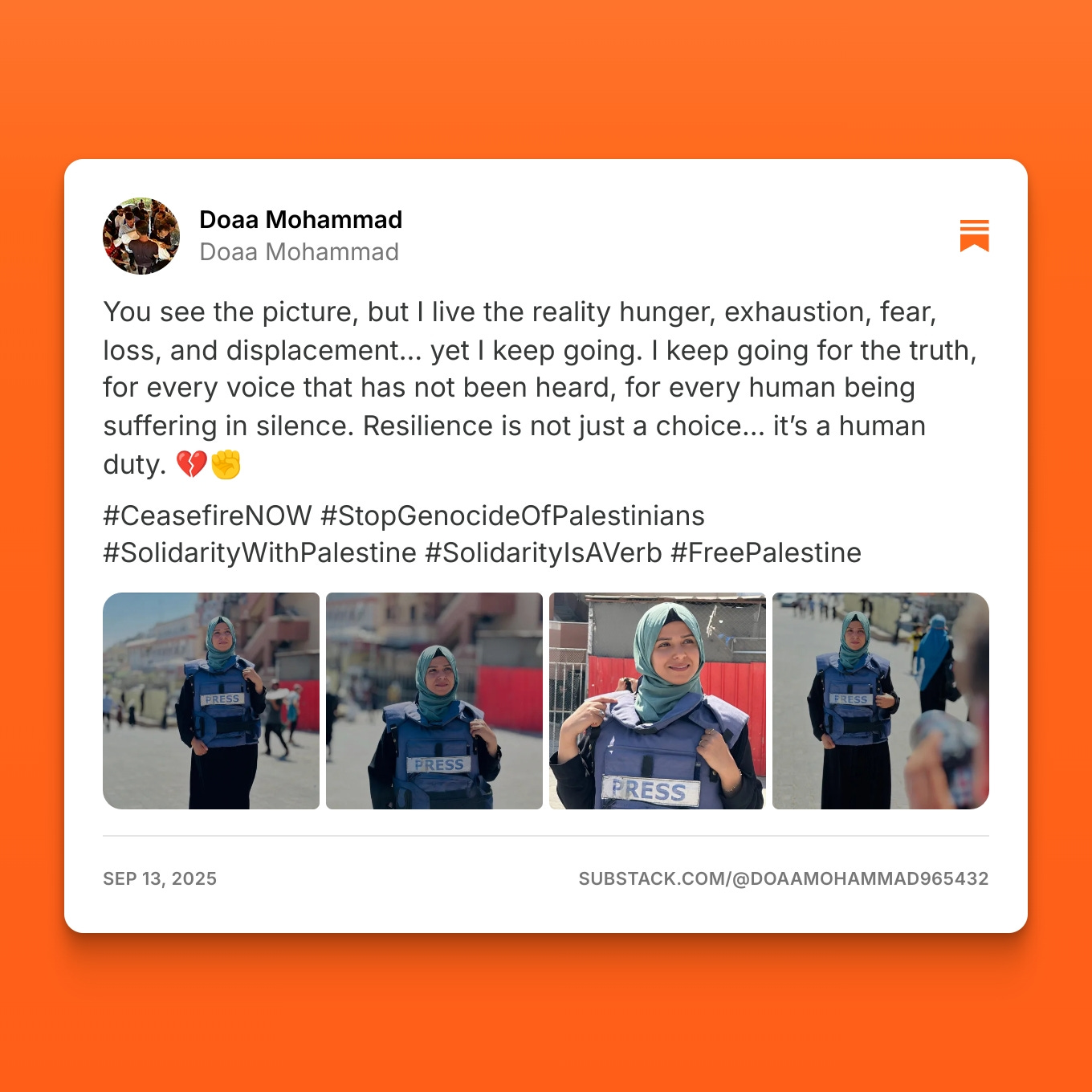
When we see a voice from Gaza still speaking, still reporting, still standing, let’s have respect for that. They may not have starved totally, but chronic malnutrition compounds over time. In impossible conditions, against impossible odds, they’re still speaking out. Something I couldn’t do after Day 3.
My hunger was my hard reset. You may find yours in different places. But go and find it. The fire will fuel direct action and personal engagement. My goal is that by reading about my journey back to embodied empathy, you might find a pathway for your own that doesn’t require such a drastic measure. Mere witnessing is no longer enough.
Witnessing was never enough.
truly profound. thank you for sharing your experience.
Powerful piece about your powerful insights, thanks Khatoun. I worry that I have become desensitized after seeing so much awfulness, so this is an excellent reminder that intellectualising what's going on is all very well, but truly feeling it needs bodily involvement.