
The Persian Subject
Part One: Antoin Sevruguin and the Qajar Gaze

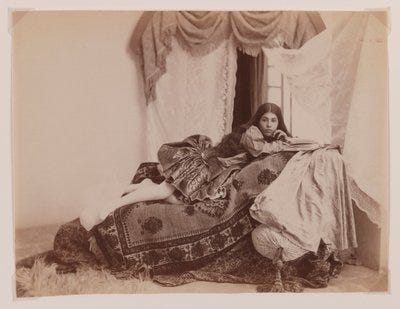
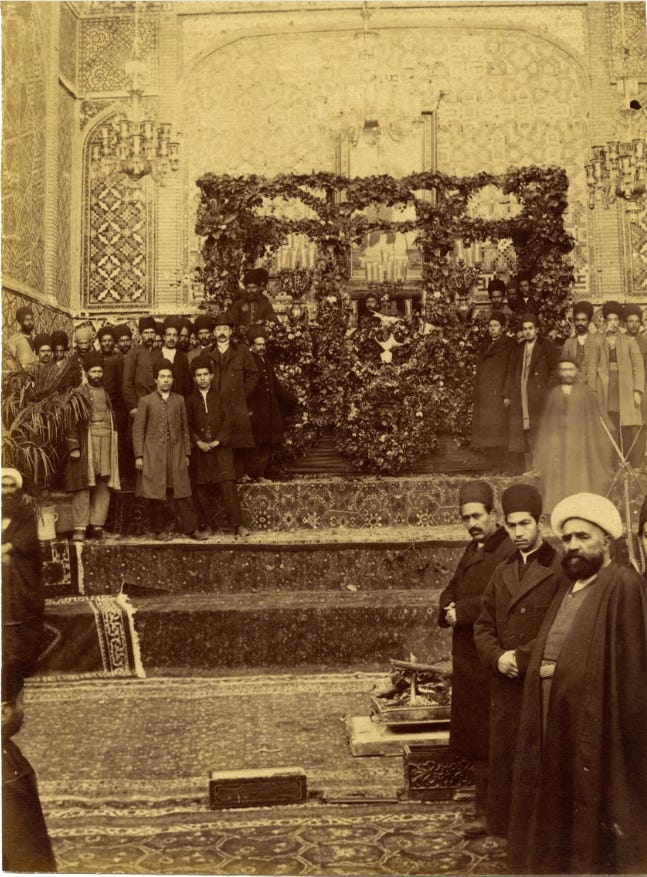
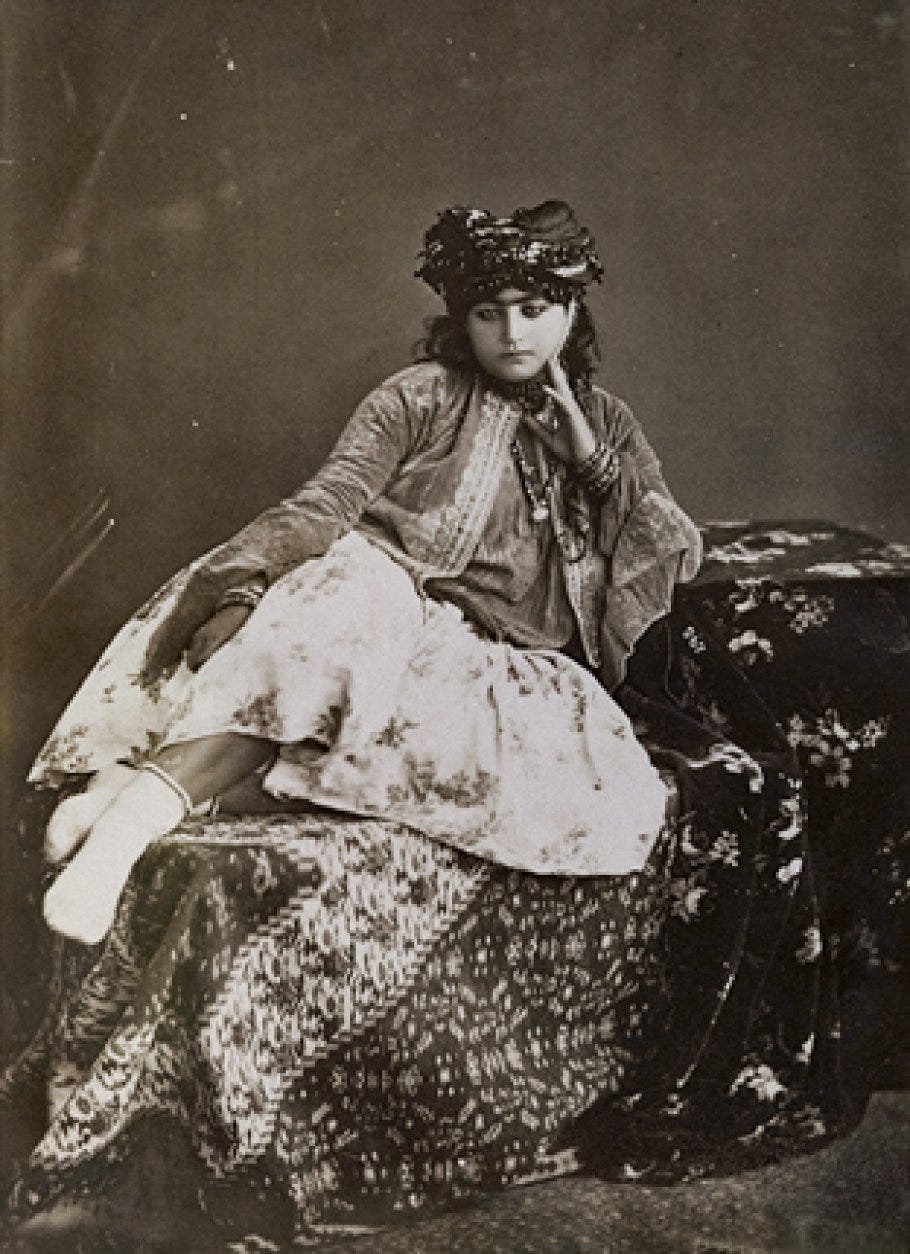
He photographed courtiers, the grand vizier, the once-minister of war. He took pictures of sights no eyes were allowed to see and survive: Circassian beauties in the andaruni, unveiled, suggestively reclining, bedchambers of the royals and possibly even banter with various employees of the court in cross-dress.
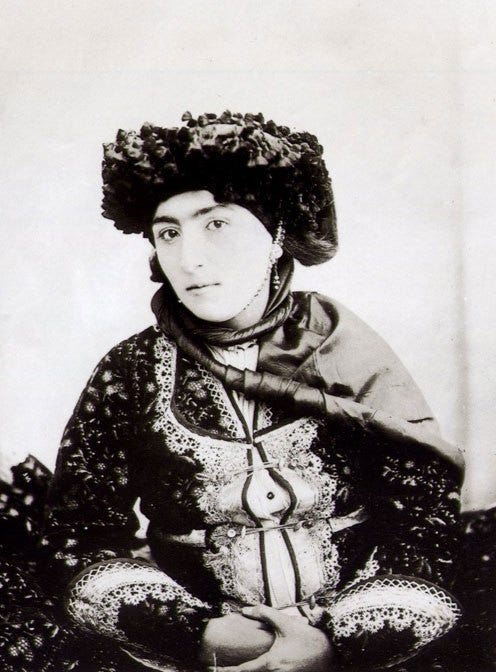
He took pictures of unveiled Kurdish women in remote villages. Of Talysh laborers with hardened hands and peasants selling produce. He even managed to catch images from secretive dervish circles… in late 19th century Persia.
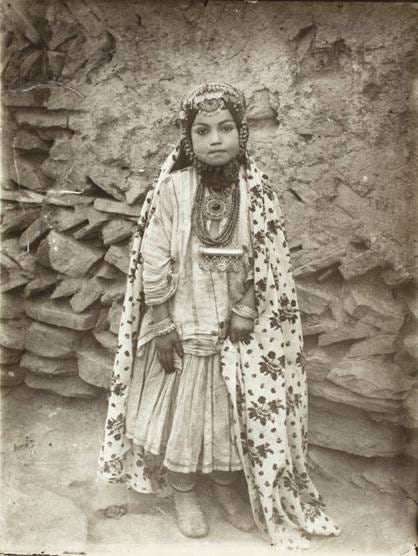
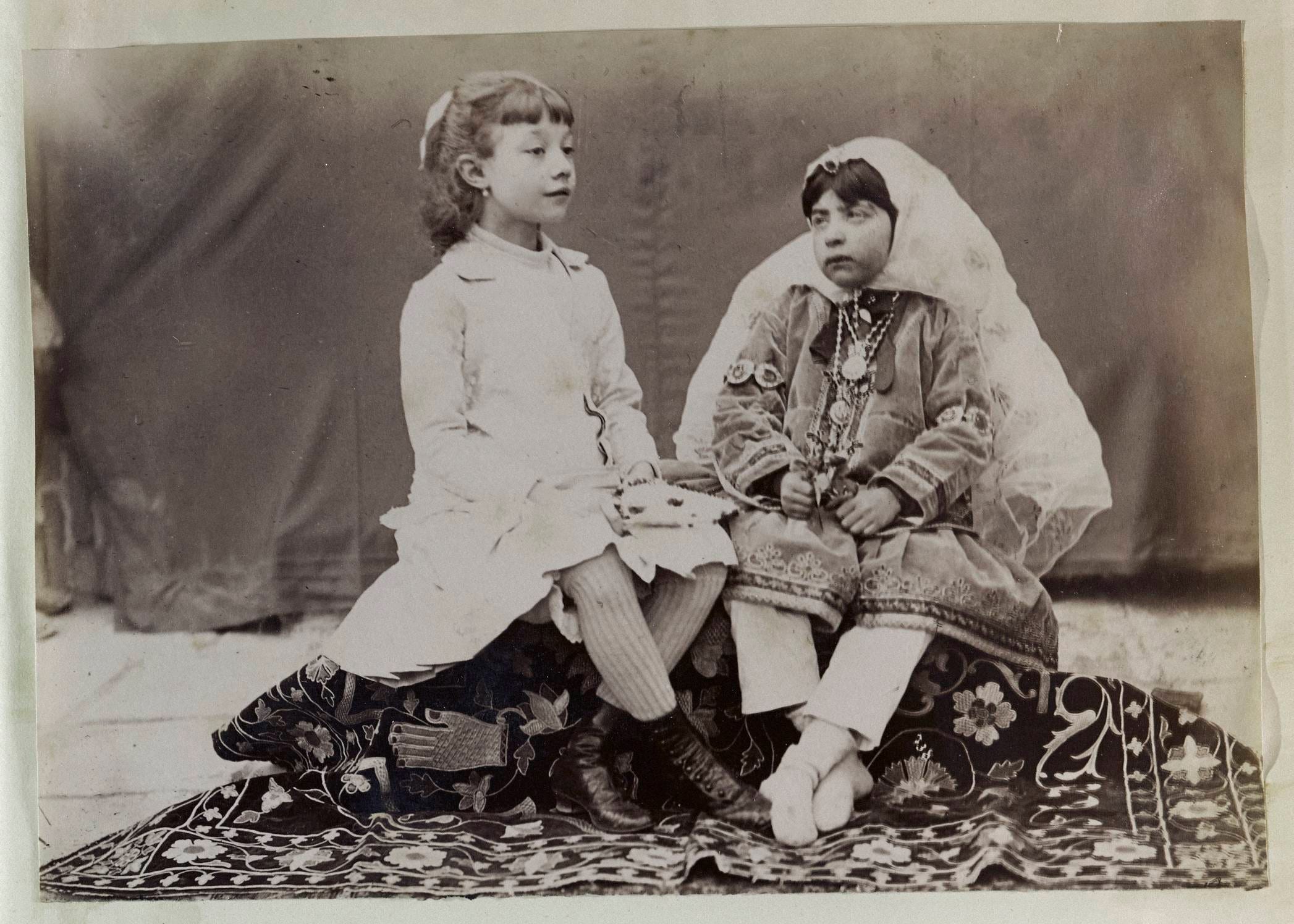
He had an eye for perspective. The images are stunning, the subjects alive, even over a century later. When I look at the eyes of the little Shahsevan girl I feel like she could be my own child, alas, she is already long gone. When we speak of the visual memory of an entire nation, more precisely, an entire civilizational sphere in one of its most vulnerable, convulsive and unstable periods, the evidence upon which we base our understanding of ourselves and our progenitors is intrinsically tied to one man’s camera.
And yet.
Most of his life’s work has been destroyed, twice over.
And what remains is largely out of reach to us, sanctioned peoples from the “axis of evil”, as it resides in the Smithsonian.
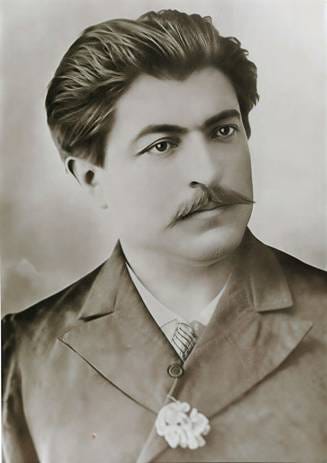
Who was this man who took upon himself, consciously or unconsciously, to preserve the memory of a nation in labor pains?
His name is a mystery. And that is indicative. Anton, Antoine, Antoin (as he styled himself), Sevruguine, Surugin, Souroughuine, Sevrugian… There are many more variations. It is almost as if the region’s indigenous and imperial influences cooked within the same cauldron, seasoned with some good old occidentalitis, to produce a man simultaneously entirely singular and perhaps the best representation of this era of our joint history.
He was born in 1851, in Imperial Russia, or more precisely, on the tiniest differential element of its soil within the Guarded Domains of Iran – the Russian Embassy in Tehran. His father, Vasily, or Vassil, according to popular and often slightly “wrong” fashionable “French” versions of names, was a diplomat. His mother, Ashin-Khanoum, has no attested surname. But despite that lack, her historical footprint is much clearer than her husband’s. After he tragically died from a horse fall, she fought to receive his pension. There are two versions of the story: in the first the Russian Embassy denied her request, in the second, by the time they approved it she was sufficiently slighted to refuse it and take her children to her homeland.
Ashin-Khanoum was Georgian, and so, the family settled in Tbilisi. We know young Anton was talented, and that he studied painting before growing up to be a very handsome, and very industrious young man. His favorite medium quickly switched from painting to photography that could support his mother and siblings better, via producing postcards. In Tbilisi, a fateful encounter happened. The three brothers, Anton, Kolya, and Emmanuel, all interested in photography, became acquaintances and disciples of none other than Dmitri Yermakov.
The man who kindled the Russian imagination with his photographs of Persian life. The quintessential orientalist of the time.
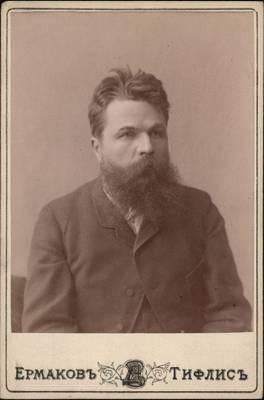
And for Anton, something probably shifted. He felt a pull to the old home, where his late father served. Soon, in 1870, a 19-year-old Anton and his brothers moved to Tabriz. He proved socially skilled, adept in flattery, and quickly made friends in high places. He soon became the favorite of the Crown Prince Mozaffar ad-Din Mirza, even his personal confidante and protégé. The Crown Prince, known for his taste for luxury and everything European, showered young Anton with gifts. He even bestowed upon him the lordly title of “Khan”. And when it was time for him to prepare to assume power, Anton followed the Prince back to Tehran.
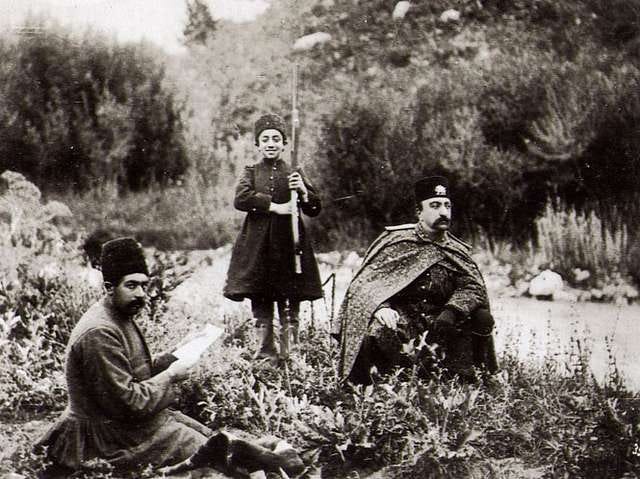
It is no coincidence that the new Shah, once the governor of Azerbaijan and Anton’s patron, became so invested in photography. Within the decadent, heavily indebted late Qajar dynasty, he was the Crown Prince in title, but known as a weakling, a pushover, or more generously, a gentle and curious man who cared more for art than for governance. Like his father, he had a hunger for everything French. During his visits to France, he became obsessed with cinema. As he was plagued with numerous physical ailments, most distressingly heart failure that afflicted him since his youth, he sought a second, more expansive life through the silver screen. As an excerpt from his diary states: “...[At] 9:00 p.m. we went to the Exposition and the Festival Hall where they were showing cinematography, which consists of still and motion pictures. Then we went to Illusion building ....In this Hall they were showing cinematography. They erected a very large screen in the centre of the Hall, turned off all electric lights and projected the picture of cinematography on that large screen. It was very interesting to watch. Among the pictures were Africans and Arabians traveling with camels in the African desert, which was very interesting. Other pictures were of the Exposition, the moving street, the Seine River and ships crossing the river, people swimming and playing in the water and many others that were all very interesting. We instructed Akkas Bashi to purchase all kinds of it [cinematographic equipment] and bring to Tehran so God willing he can make some there and show them to our servants.”
Akkas Bashi, or “head photographer” was Mirza Ebrahim Khan, the son of the late Shah’s photographer and the official cinematographer of the court who produced the first film in Iranian history. A short clip of the Shah leisurely walking around in Ostend, Belgium.
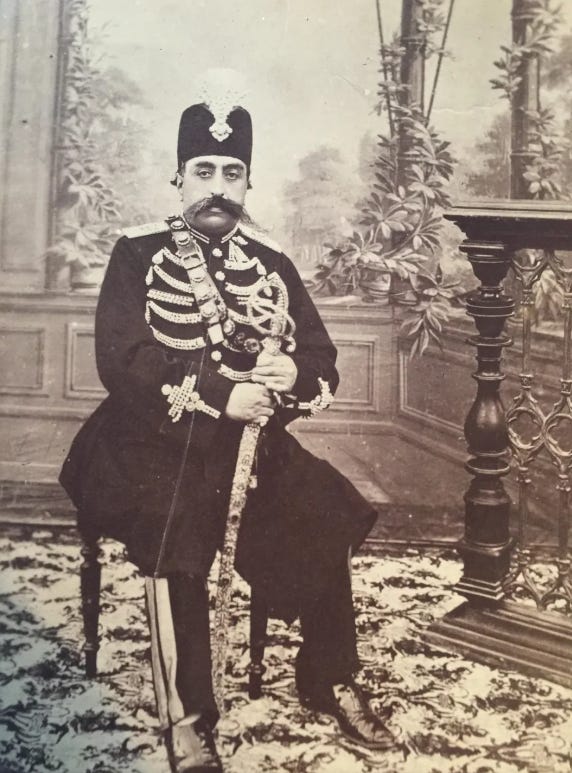
Although he was no Akkas Bashi, nor held official court position, things were going great for Antoin in Tehran. He established his atelier on Avenue Ala ad-Dawla, and it soon became a hotspot for westerners in search of postcards depicting “Persian Types”. This is also the time of his nearly unlimited access to the court, perhaps precisely because of his lack of official ties to it. Reviewing the Shah’s correspondence, we can infer that Antoin’s presence in the harem wasn’t incidental or clandestine, it was, quite simply – requested. The Shah wanted western, orientalistic pictures of his own world taken in the same style he admired in France. Antoin, trained by Yermakov, knew how to produce just that. The image of the unveiled Circassian concubine is not an aberration, it is an artifact of a profoundly split psyche of the late Qajar era, so enamored with both the West, and the oriental, magical undertones the west painted it with.
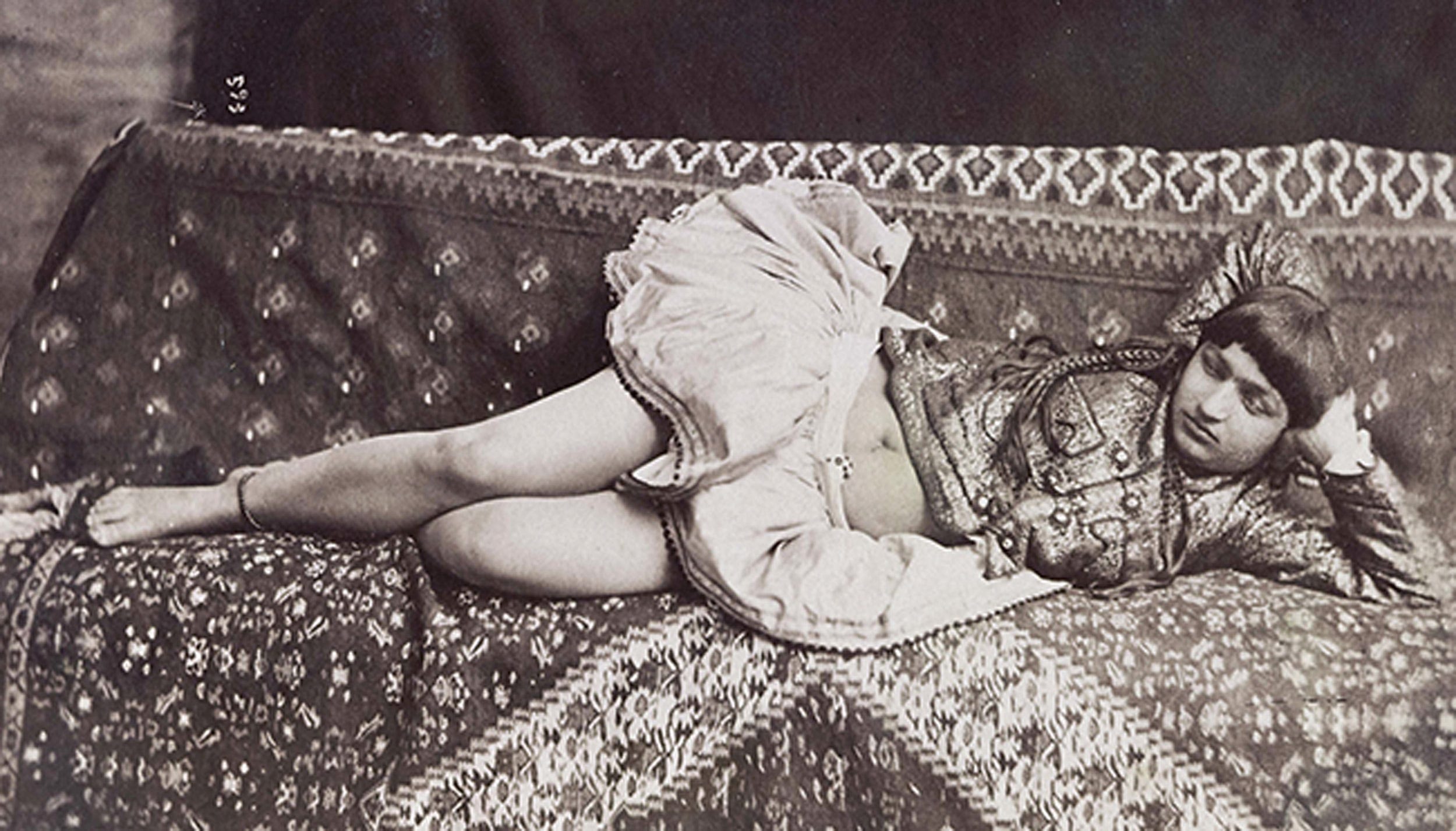
This is perhaps an uncomfortable and necessary point to ponder. In discourse about orientalist art we are usually confronted with a clear case of an European outsider “usurping” the naivete or good will of native subjects, and producing art that serves European libidinal functions, by virtue of showing them the Orient of their imagination as fact, rather than projection. However, in the Qajar case, the case is significantly more complex. It is not that the Qajar court was full of victims of European orientalism, not in any pure sense. It was full of its consumers. Mozaffar ad-Din Shah saw himself both as a fascinating oriental despot, and as a consumer of fascinating oriental pictures that would be worthy of his “refined”, “European” tastes. The desire to produce an orientalized version of the court, even the andaruni, was rooted in this double desire; to show oneself to the Other as the Other, and to collapse the distance between the observing civilization (West) and the observed (East). I refer the reader to Al-e Ahmad’s usage of the parable of the donkey in lion skin. It is a fascinating psychological study in a deep internal colonization of a psyche on an individual and social level.
And this high would last for a decade.
The eighties and nineties would bring another personal success to Antoin. He would meet Louise Gourghenian, the mother of their seven children, who all survived into adulthood.
The studio on Ala ad-Dawla Avenue and the adjacent home were soon overrun by children’s footsteps. It was all well. He was a wealthy man, a respected man, a cosmopolitan. He still declared himself to be Russian, which gave him a particular mystique in late Qajar courtly society. The fact that his wife was very much Armenian didn’t register in the same terms we would think of today. Vasily, his Russian diplomat father who died tragically young, was himself Armenian after all. The surname Sevryugin merely denoted a connection to a prestigious sort of stellate sturgeon that produces expensive caviar. Perhaps Vasily had named himself that upon entering diplomatic service. The name of the fish, севрюга, is Kipchak or more contemporarily, Tatar in origin. All that cosmopolitan flair was in its essence – a rather stinky fish. The Caspian doesn’t let go of its peoples.
Those were the golden years of Antoin Sevruguin’s career. He was prolific. He photographed everything; from field photography in villages, to courtiers, to concubines, to landscapes, to the Royals themselves. The Golden Age of the atelier, sadly, wouldn’t last much longer. The Shah was ailing. His heart condition had become a public secret. Around the same time, the nearly-bankrupt state had to impose tariffs to repay a Russian loan granted personally to the Shah so he could go on yet another luxurious tour. The people, particularly the merchants and later the peasantry too, rebelled against this: in 1905 mass protests broke out. The government responded with brutality. The situation escalated out of control. By 1906, the Shah, already dying of cardiorenal failure, caved in to the requests, and the first Constitution in Iranian history came into power. Elections were held.
The Guarded Domains now had a Parliament.
It is unclear what Antoin’s political opinions were before the death of Mozaffar ad-Din Shah. However, after his death in 1907 and the violent ascension of Mohammad Ali Shah Qajar, who rendered the Constitution null, his political side seemed to shift. The Russians, aligned with the moribund monarchy at all costs, became an uncomfortable political burden, when the “other” side was that of Khetcho, Yeprem Khan, Arshak Gavafian Keri, and Sako Sevkaretsi.
From 1907 onwards, Antoin Sevruguin was no longer Russian. At the very least, he no longer referred to himself as such.
He referred to himself as “Iranian”.
And then – fire.
Tragedy distorts reality, that is why, perhaps, we have two different versions of the same event in 1908. In the first, Cossack militias had been dispatched to firebomb the Tehran residence of a rogue constitutionalist governor of Rasht, connected with the activities of Armenian and Jungle militias in Gilan. In their rabid onslaught, they set fire to the adjacent house too, and Antoin-Khan’s atelier on Ala ad-Dawla Avenue paid the ultimate price. Thousands of glass plates, and the vast majority of his life’s work were destroyed by accident, or misfortune of proximity.
There is a second story, championed by the photographer’s illustrious son, Andre. That his father was, in fact, a Dashnak in secret, and that he clandestinely financed the ARF. That he was then betrayed and that the fire was vendetta for his supposed clandestine activities.
However, other than these verbal accounts that still live on in the Parskahay community as legends, there is practically no evidence that Antoin-Khan was ever politically active, neither as a constitutionalist, nor as a Dashnak.
A third story, the least interesting but perhaps most indicative of the fate of mercantile minorities in dying empires appears to me as speculation. It is neither that the fire was an accident, nor that he was targeted because of some particular political stance. The Cossack brigades weren’t composed of intellectuals; as even their most famous member would later show, they were comprised of brutish, largely illiterate youngsters from Iran’s equestrian minorities. When given the task to firebomb the governor’s residence, they noticed a wealthy Armenian’s shop adjacent, and just went ahead and burned it too. The destruction was widespread, that much we know. Dashnak or not, a wealthy Armenian was guilty by association, and if not – who cares? No amount of cosmopolitan sophistication could save Antoin-Khan’s glass plates. No spelling of his Russian surname, no manner in which he styled his moustache. It didn’t make a difference that at this time there is no evidence of him considering himself Armenian at all! Whatever he thought he was, the fire made the decision for him. Such were the times of violence and madness.
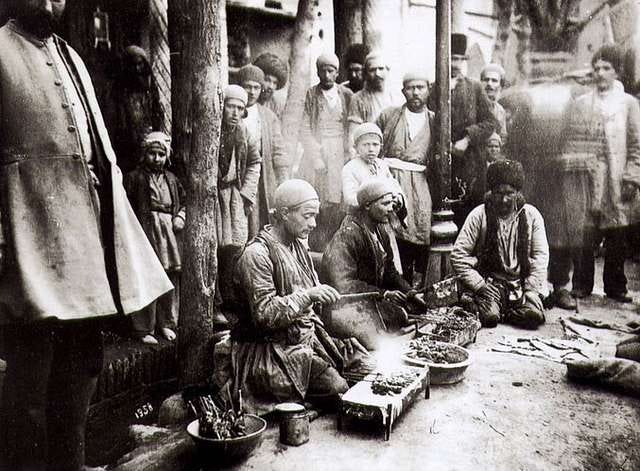
But his spirit was not broken, on the contrary. Largely barred from the court, he turned his lens to different subjects. The rural series in the North commenced, and it is the only good ethnographic evidence we have for some groups in the early 20th century: Shahsevans, Tats, Talyshes, Gilaks. His images of Kurdish women garnered some fame, and some controversy: widely denounced as orientalist imagery and products of an “European” imagination.
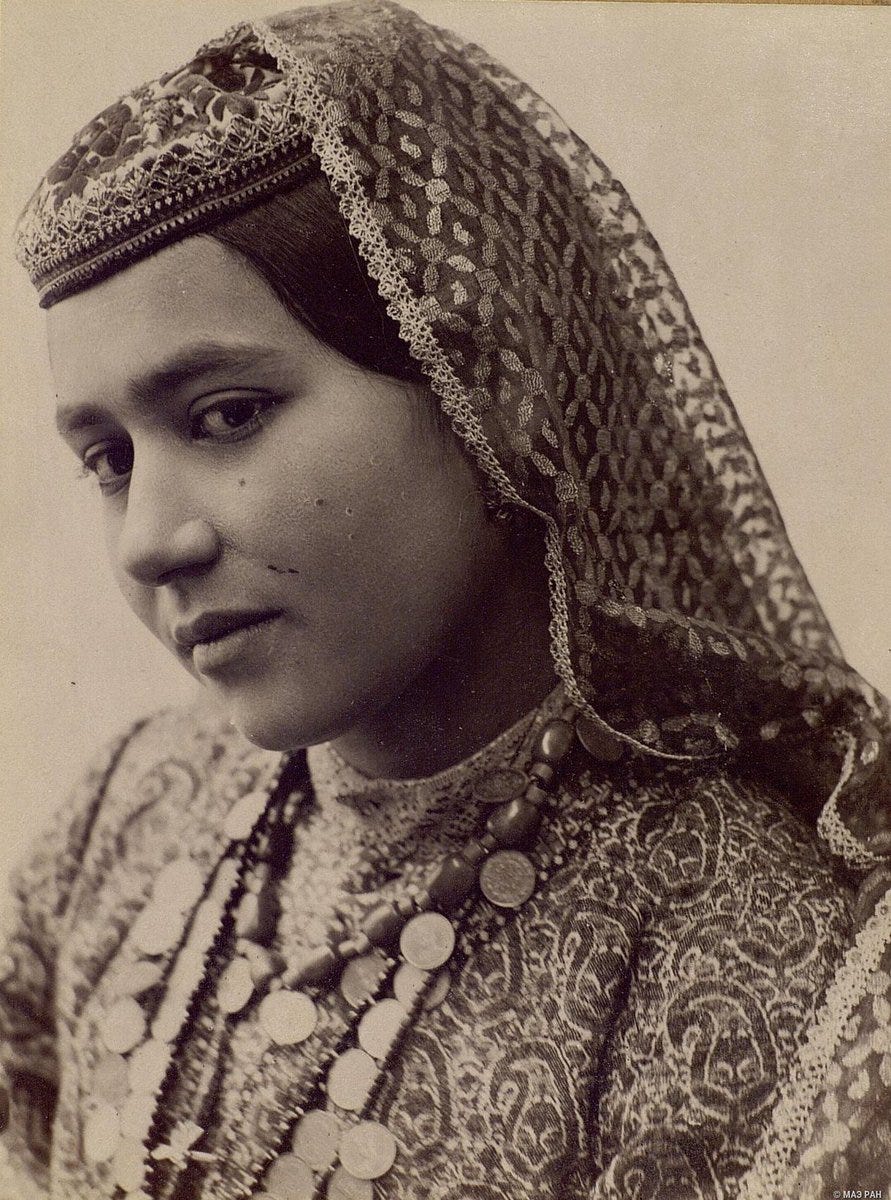
Back in Tehran, he photographed the Armenian and Assyrian community extensively. Some of the best evidence of urban Armenian dress in the 1910s in Tehran comes from his images. He traveled extensively, and from his folios surviving to the present day that can be accessed a particular series of portraits of itinerant dervishes stands out.
There is a particular image I’d like to show you, one of a young dervish in religious ecstasy.
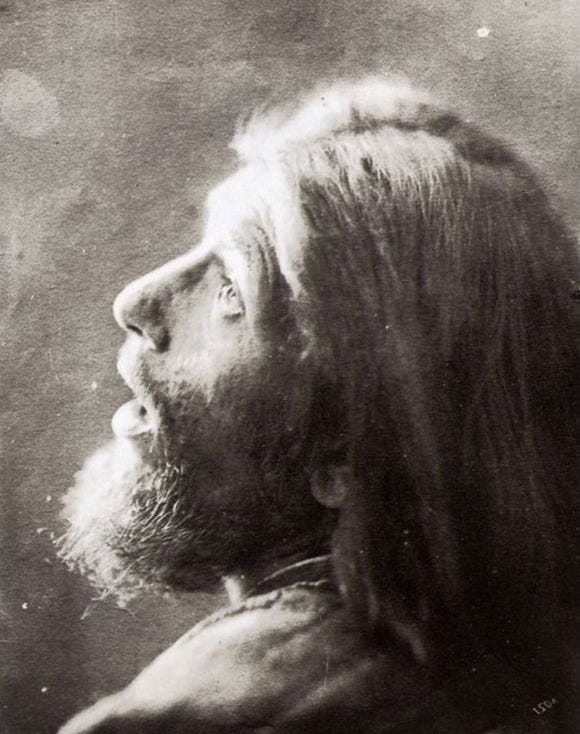
Now, given the photographic technology of the time and the long exposure… keeping such a pose would’ve proven exhausting even for a skilled actor. And from the ample pictographic evidence of Sevruguin’s interactions with the dervishes, it seems more likely that they were friendly, his regular subjects, and that he was somehow allowed into their usually secretive and elusive circles.
No small feat for an Armenian.
It is perhaps the reason why his son, Andre, styled himself “Darvish” as a miniature painter.
In the 1910s, he briefly tried to branch out into cinematography. That didn’t work. His business had already established a niche. He produced postcards with Persian types, and was the best in the trade. European diplomats and travelers from the orient hoarded his folios, and they were the preferred souvenir to take back home.
It mattered not that what he depicts remain totally ethnographically accurate. Such as in Mozaffar ad-Din Shah’s French infatuations, the spirit trumped literality, and the Orient was a hot commodity. Antoin-Khan had seven children, his studio had once already been destroyed, and he was no longer in the absolute mercy of the court. Beggars can’t be choosers.
The orientalist criticism levied against him is perhaps not only anachronistic but deeply misplaced: he was not only a product of his time, but already Othered, already a member of a mercantile minority in grave danger. Perhaps Sevruguin’s biggest crime is that he performed cosmopolitanism and European sophistication too well; what made him beloved at the Qajar court in his glory days made him suspect afterwards. And mislead a generation of art historians into judging him by standards reserved for outsiders looking in. The truth of the matter is that Sevruguin was an Oriental man by all standards, just one adept at performing in European garb.
We don’t know much about the rebuilding of the atelier and the recovery in the last decade of the Qajar monarchy. These were the difficult years, perhaps most difficult in Parskahay history. In 1915, the Armenian genocide happened just across the border, in Eastern Anatolia. A mass of refugees fled to the Guarded Domains. Two years later, de facto British occupation would cause a genocidal famine in the country. By some accounts, over half of the Persian population would die by 1919. In those same difficult years, the October Revolution happened, and Armenian Bolsheviks branched their activities out into the Iranian North. The jangalis, the former allies of the Dashnaks and other antimonarchist factions, started disseminating materials and uniting.
In 1920, in Anzali, Ferqe-ye Edalat, or the Communist Party of Persia was born. The political landscape would never return to a monarchistic status quo. As the British installed their preferred puppet onto the now-completely decadent Qajar throne in order to combat the Soviet threat, a puppet who was one of those same illiterate Cossack firebombers, the atmosphere would shift once again. British tradesmen, diplomats, spies and travelers would sweep through the decimated streets of Tehran… and suddenly… there would once again be a need for orientalistic postcards.
But the bliss was short-lived.
In 1924. The semi-literate Georgian-Tabari Cossack officer, now styled Shah, found issue with “backward” depictions of Iranian life. Iran was to become modern and western. All evidence of its former “backwardness” had to be erased. Even if it was all a charade performed for European eyes. All of Sevruguin’s Qajar glass plates were confiscated… and supposedly destroyed.
The photographic atelier survived once again. It kept working. Producing portraits, though not much is known about its later years. In Iranian art history, the magnifying lens now shifts to Andre, “Darvish”, who was Ostad Behzad’s classmate, and one of the more illustrious miniaturists of this generation.
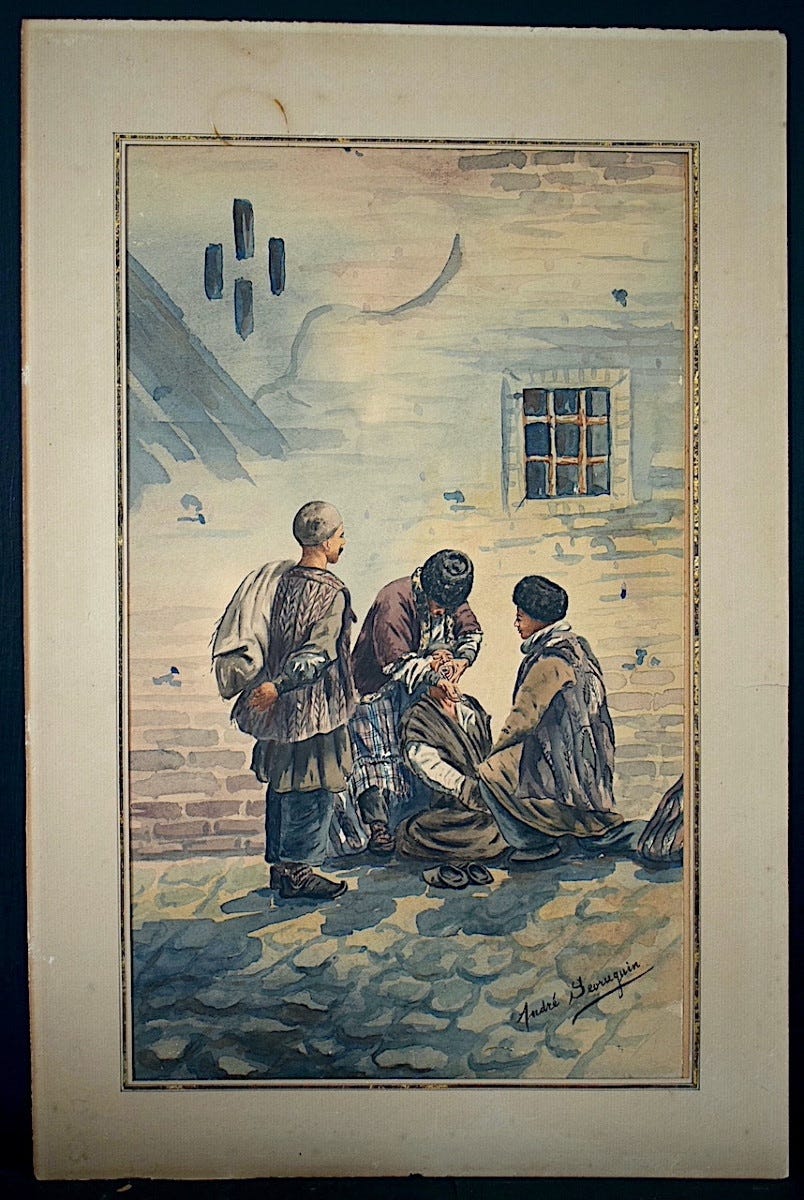
Antoin Sevruguin died in 1933, aged 82. The atelier still produced photographs even after his death. One of his children likely took over, though that I can not confirm. At the time of his death, a large number of previously lost glass plates and folios got rediscovered by some Yank, and taken to the Smithsonian. Out of reach for the descendants of the people depicted.
Thus, a third death for a work that survived two assassination attempts. Two empires have tried to destroy it once it became inconvenient, because witnesses always are.
And now a third prevents the descendants from gaining access unless they sell their souls for a green card.
The little Shahsevan girl is trapped behind glass, seen only by eyes who would’ve authorized her killing if she were alive today.
The Armenian girls are shown to those who keep bombing their granddaughters in Isfahan.
Like many of us, they remain stolen. They aren’t coming home.
Such are the circles of life in this haunted land. And yet, curious eyes always find a path.
This is a stunningly layered piece: both visually attentive and intellectually ambitious. I really appreciated how you hold Sevruguin between categories (court insider/outsider, Orientalist/subject of orientalism, Russian/Armenian/Iranian), and refuse any neat resolution.
Sevruguin's photography is also one of the rare visual archives I’ve found very useful for my research on Iranian women’s clothing across regions and classes.
Thanks for this, and looking forward to Part Two!
This story left me speechless. Stunning, evocative, emotional and at the same time, solid piece of research that must have costed time. The photographs remain, yet we know very little about the author. The story of his atelier tracks the tragic story of the nation, torn between interests of superpowers. And the picture of a dervish has stunning resemblance to how Christ is portrayed in western popular culture.
It also resonates because I spent time in Tehran, made friends, listened to stories and wrote about them (my recent stories are in Tehran and Yazd)
But if I may, I’d like to leave here something else, which came immediately to mind. Two month ago I’ve done research similar, in its nature, to yours. I ventured to understand a story of my piano, gathering dust in the corner. It ended up a reflection on what the country went through over a century. Again, thank you for this moving article.
https://nomadicmind.substack.com/p/the-worst-investment-ever-and-a-hundred